Category: Poems & Photographs

  • Francine in Paris – Day 7+

    If you come to Paris, if you love art and music, you must attend an evening concert at Sainte Chapelle.  Imagine sitting in a high Gothic chapel with stained glass windows on 3 sides. At dusk, the light still illiminates the stained glass in an array of red, gold, green, purple and blue colors.  Imagine “…Fifteen magnificent stained glass windows separated by the narrowest of columns that soar 50 feet to the star-studded vaulted roof.”

    The 7 member ensemble walks into the altar area, 4 violins, 1 violin-cello, 1 bass viol and 1 harpsichord.  Not one word is spoken.  Only the stage is lit.  The musicians launch into Pachelbel’s Canon, Albinoni’s Adagio and Vivaldi’s Les Quatre Saisons.  One encore.  Wow.  At times, I just closed my eyes and savored the superb music in that special place.  Paris Three 2010 291

    Sainte Chapelle was dedicated in 1248.  French King Louis IX was so devout he was later canonized.  He may be the only French King who was a saint.  He built this chapel to house Christ’s “crown of thorns” (now at Notre Dame Treasury) and for worship by the royal family (upper chapel).  The servants used the lower chapel.  Louis paid 3 times more for the relics than for the chapel.  Hmmm.

    Whatta day!


  • Francine in Paris – Day 7

    The loudspeaker came on at 2 PM in the Louvre.  “Everyone must evacuate the building.   When the situation is over you will be allowed to return.”  Right.  Goldfinch.     (I was near Corot.  Which priceless treasure should I rescue on the way out?). I started to stride purposefully toward the nearest green sign depicting someone running like a bat out of hell when  I noticed that no one was rushing the exits.  Then I came upon Deanna who said that she had not heard that announcement.  So. What gives.  Do they just selectively terrorize the tourists; do they want to clear out a few galleries so they can squeeze in another tour?  Yes, it was Just another day of sensory overload at the Louvre.

    First stop this morning was Place de la Concorde with the Egyptian obelisk, 3200 years old from Luxor, in the center, la tour Eiffel in the distance and a gigantic Ferris wheel along the street by the entrance to the Tuilleries and Le musee de l Orangerie.  During the Revolution, 1,119 people died here on the guillotine including Louis XVI, Marie Antoinette as well as the ones who sent them there: Robespierre and Danton.


  • Francine in Paris – Day 6

    Who could fail to enjoy a place like this?  Le Mur des je t’aime = I love you:  the wall.  Imagine a wall in a Parisian park.  On the wall you see the words, I love you, written  1,000 times in 300 languages in many different scripts.  On a sunny day like today, you come here to point to the words that say “I love you” in your language and have your picture taken.  Lovers stroll here arm in arm.  A young French woman sings love songs as she plays the accordion for spare change.

    The wall is the brainchild of Frederick Baron.  He wanted the “image of a wall on which the principle languages and dialects of the planet glittered like stars in the sky.”  Address:  Paris, Butte Montmartre, Place des Abbesses in the Square jean Rictus in case you’re in town.

    The big draw on Montmartre is La basilique du Sacre-Coeur with its white turrets and domes.  Folks sit on the  front steps and gaze out over Paris or photograph themselves with their selfie sticks and giggle.  Inside is the place of the Gold Leaf.  Wow.  The exquisite mosaics and statuary are elaborately decorated with glittering gold.  “At the outbreak of the Franco -Prussian war in 1870, two Catholic businessmen made a private religious vow to build a church dedicated to the sacred heart of Jesus should France be spared the impending Prussian onslaught.”  It was and they did.  One of the two men, Alexandre Legentil, had his heart buried in a stone urn in the underground crypt.  Hmmm.  Home is where the heart is?  Work began in 1875 and finished in 1914, but the consecreation was not until 1919 after France survived World War I.  Too many wars!

    My favorite place in Montmartre is the church of St. Peter, a stone’s throw from Sacre Coeur.  The church has a long, checkered history shrouded in legend and has been almost destroyed by fire and edict a number of times.  Legend has it that St. Denis, missionary to the Gauls, was beheaded here with two of his companions, Rustic and Eleuthere.   However, St. Denis picked up his head and walked to the site of his sepulture where the church now stands.

    On this visit I noticed several new things.  First, I found in the church the inscription that indicated Queen Adelaide, wife of King Louis VI, was buried here.  In 1133, the church that was here was given to the King who decided to found an abbey under the protection of the crown. Later, Adelaide joined the convent here and specified in her will that she be buried in the choir of the church.  Her burial marker is modest, indeed.   The most dramatic part of the church is now the 27 windows of stained glass by Max Ingrand installed in 1952 and 1953.  They represent Christ, the life of St. Peter and the saints of Montmartre.  On a sunny day like today, the rainbow colors fall on the pillars and aisles in carpets of primary hues.  Lovely.

    1. The museum of Montmartre depicts the history of a home with a life much looser in style than Sacre Coeur and the church of St. Peter.  More later.


  • Francine in Paris – Days 4 et 5

    imagine dining in style at Le Caveau de l’isle, a traditional French restaurant, in a 17th century building on Isle de Sainte Louis.  Naturally, we behaved like tourists and photographed the beautiful presentation of our entrees.  Deanna was almost delirious over the apple tarte.  Delicious.  The restaurant has a large cave below for jazz until 2 AM nightly.36, rue Saint Louis en l’Isle, in case you are in town.

    We headed this morning to Notre Dame which has been a place of worship for almost 2,000 years starting with the Gallic and Roman gods.  The Romans are not far away as in the plaza in front of Notre Dame is the Crypte Archeologique.  This archeological dig  shows the ruins of the underground heating system the Romans used for their thermal baths.    Ah, the good life.

    Notre Dame began in the 13th century in the mind of the archbishop of Paris, Maurice de Sully.   It evolved over time into its present size and shape which a gazillion people visit each year.  Listening to the bells is wonderful.  Their names are Angelique-Francoise (C sharp), Antoinette-Charlotte (D sharp), Hyacinthe-Jeanne (F) and Denise-David (F sharp).  We should all have such cool names and sing on-key.  The rose windows are worth the trip.  It’s a hard-working church with many services, multi-lingual priests hearing confessions and lots of special events such as organ concerts.  I always buy and light a candle for my departed loved ones. Paul Claudel wrote, “Notre Dame is not just a building, but a living person.  Looking at it is not enough, we must live with it every day for a long time.” Amen.

    Tip:  Going to the Eiffel Tower?  Buy your ticket online a few months in advance.  Doing this means you by-pass VERY long lines. Save your sanity!   The process of  getting to the top (2 elevators) and then descending (2 elevators unless you want to walk) is slow and challenging but well-worth the views.  To see this work of art up close is a thrill.  Deanna and I read about its creation in the book, Paris, by Edward Rutherfurd.

    Paris Three 2010 205Day 4, Deanna arrived from Seattle and we went almost directly to the massive Bois de Bolougne.  In the midst of this park is the Louis Vuitton foundation which houses art galleries.  The current show is by contemporary Chinese artists.  The Really Big Show is the building itself designed by Paul Gehry as a great sailing ship on a river and basin.  Must see to believe.


  • Francine in Paris – Day 3

    Today, I made the trek to Porte de Clingancourt for Les Puces, the flea market.  The last few times I was there I had a favorite area, a narrow strip along a road with many vendors under a row of trees.  Some vendors gathered for their weekly card game under an awning.  I enjoyed looking through the bins of junk looking for treasures.  One man always responded to my questions of “how much” (in French) with “un Euro.”  Can’t beat that price!

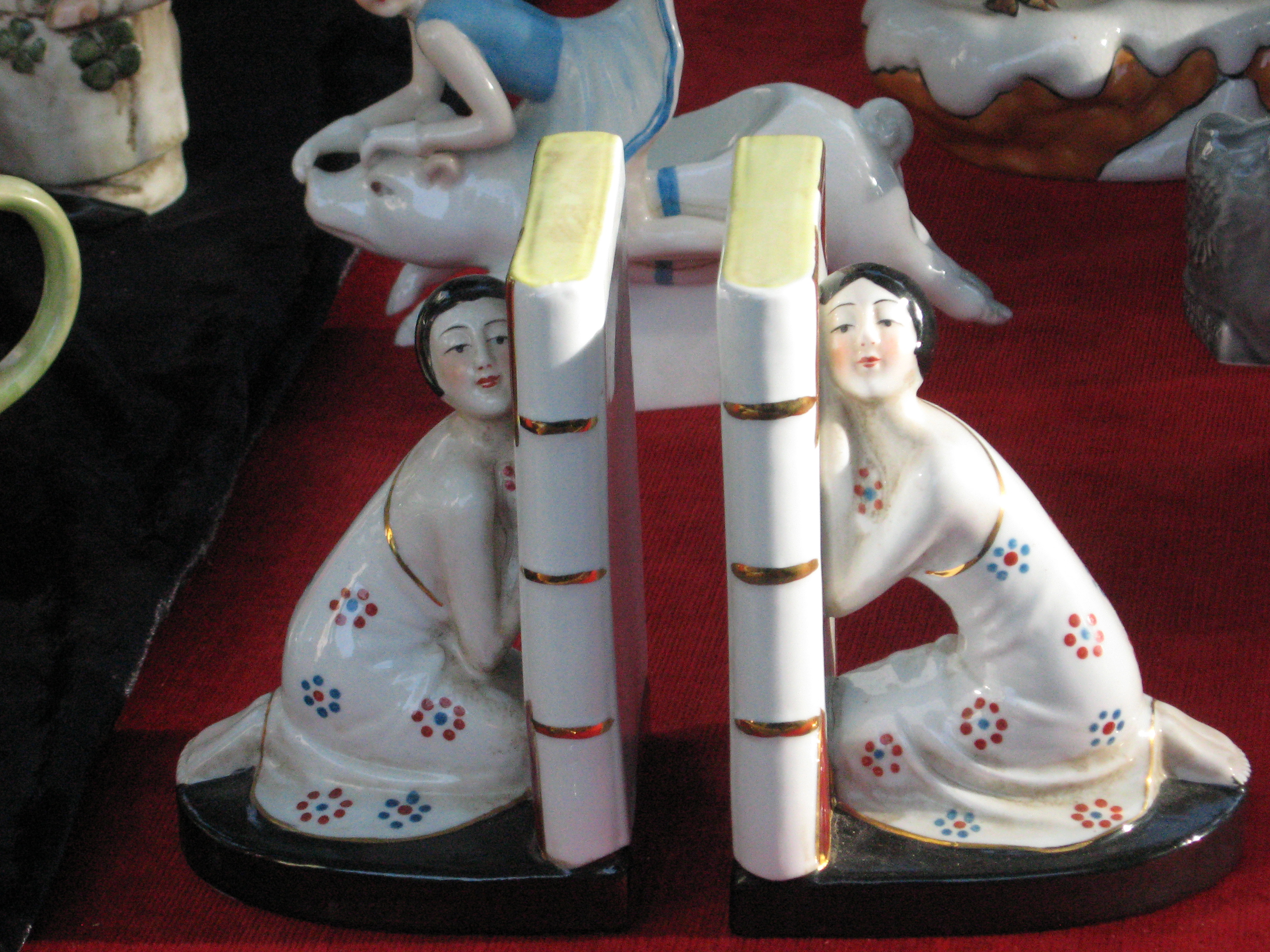
    This time, there was a mass of construction that obliterated my landmarks.  Traffic was thick everywhere.  Dozens of young men along the street walked  around hawking watches and purses.  The walkway was full of vendors selling tennis shoes and jeans.  I did find a wonderful section that I had missed before that was like a rabbit warren.  Narrow paths lead among a jumble of very small shops.  Some of the vendors looked very elderly indeed.  They had been selling antiques, methinks, for a long time and were not planning to retire.  Many of the shops sold exquisite antique French furniture.  Many other shops sold a hodge-podge of things such as Native American headdresses, old harps with broken strings, antique guns and swords, Baccarat glassware, paintings, lithographs,sets of china, tiny marbles, a horse-drawn cart without the horse, sculptures, old post cards, Persian rugs, juke boxes, marionettes and silver.  My favorite was a long, white evening gown with a black/white photo of David Bowie on the chest.  Out of my price range.   I enjoyed photographing the scene.  Only one young man rushed out of his shop to prevent me from snapping a picture of his collection of compasses.  All in all though a lot of fun.  I caught the metro back to my apartment, caught my breath, and went out to rue Cler to the bakery (brioche), the flower shop (tulips), the Charcuterie (roast chicken) and the fromagerie (Brie) gathering things for dinner.  The day was clear and sunny.  Parisians filled the cafes and the metro.  Lots of children with their proud parents were enjoying the day together.

    Yesterday, I also visited the Rodin Museum and Gardens.  They just finished a major renovation of Hotel Biron where Rodin lived and worked.  Rilke was also there for a time. This time I rented the audio guide which was well worth six Euros.  Rodin was a contemporary of Impressionists such as Monet, Van Gogh and Renoir. As a collector of art, Rodin sometimes traded his bronzes for paintings by his friends, so some of these works also hang in this museum.

    The exhibition traces the life and development of Rodin over his amazing life.  He worked and reworked some themes over time such as the story of Paulo and Francesca from Dante.  The Gates of Hell (based on Dante’s stories) is a gigantic bronze “gate”in the garden.  In the museum are works that explore the same stories.  For example, Paulo and Francesca became a large super-romantic sculpture known as The Kiss.  Well, the story in Dante is that Francesca fell in love with her husband’s brother, Paulo.  When they kissed for the first time, her husband saw it and stabbed them both to death.   There’s also the man who ate his children.  Hell, indeed.

    Many of Rodin’s works are breathtakingly beautiful.  Rodin thought that beauty derived from character.  Ugliness was anything false or artificial.  “According to the artist, everything in nature is beautiful.”  True beauty also lies in ugliness.  One example of this is a bronze called “She who was the helmet makers once beautiful wife.”  This is based on a poem by Francoise Villon (1460) about a woman who mourns her lost beauty.  Rodin made a nude sculpture of a very aged woman who he considered beautiful.

    One feature of this museum is a series of short films. In one film, Rodin in old-age is enthusiastically chipping away at a sculpture with hammer and chisel with flecks of stone landing on his bushy beard.  He’s talking to someone off-camera and laughing.  How wonderful to be able to see this man not as a long-dead icon  but as a man enjoying his art and being the center of attention.  I loved seeing his art, but it was the film clip that brought it all alive to me.

    Yippee skippee, tomorrow Deanna arrives, and we’ll go to the Bois de Boulonge to see the Louis Vuitton building.  C’est la vie.Paris Three 2010 182