 I send you my daughter
who could not be
her body magical as fog
rising in wisps among the grasses
playing dress-up
laughing
wrapping herself in parachute silk
dancing free
in the hills of cedar
FEWalls
I send you my daughter
who could not be
her body magical as fog
rising in wisps among the grasses
playing dress-up
laughing
wrapping herself in parachute silk
dancing free
in the hills of cedar
FEWalls

His scent lingers
near his bedroom door,
I sniff the air –
a startled deer –
then feel his absence
in the molted room.
 If I were young in Wales,
and studying Chaucer in Swansea with students
from Llanelli or Carmarthen or Merthyr Tydfil,
I would hear the cleaning woman who chatted as she worked near
my room that overlooked the gardens not the Bay.
She would say, arms outstretched,
“Open your arms wide to life,
take it all in, right now,
nothing between you and life,”
then she would hug me breast to breast.
If I were young and in Wales,
I would go to the gardens
my student’s black gown worn over my clothes,
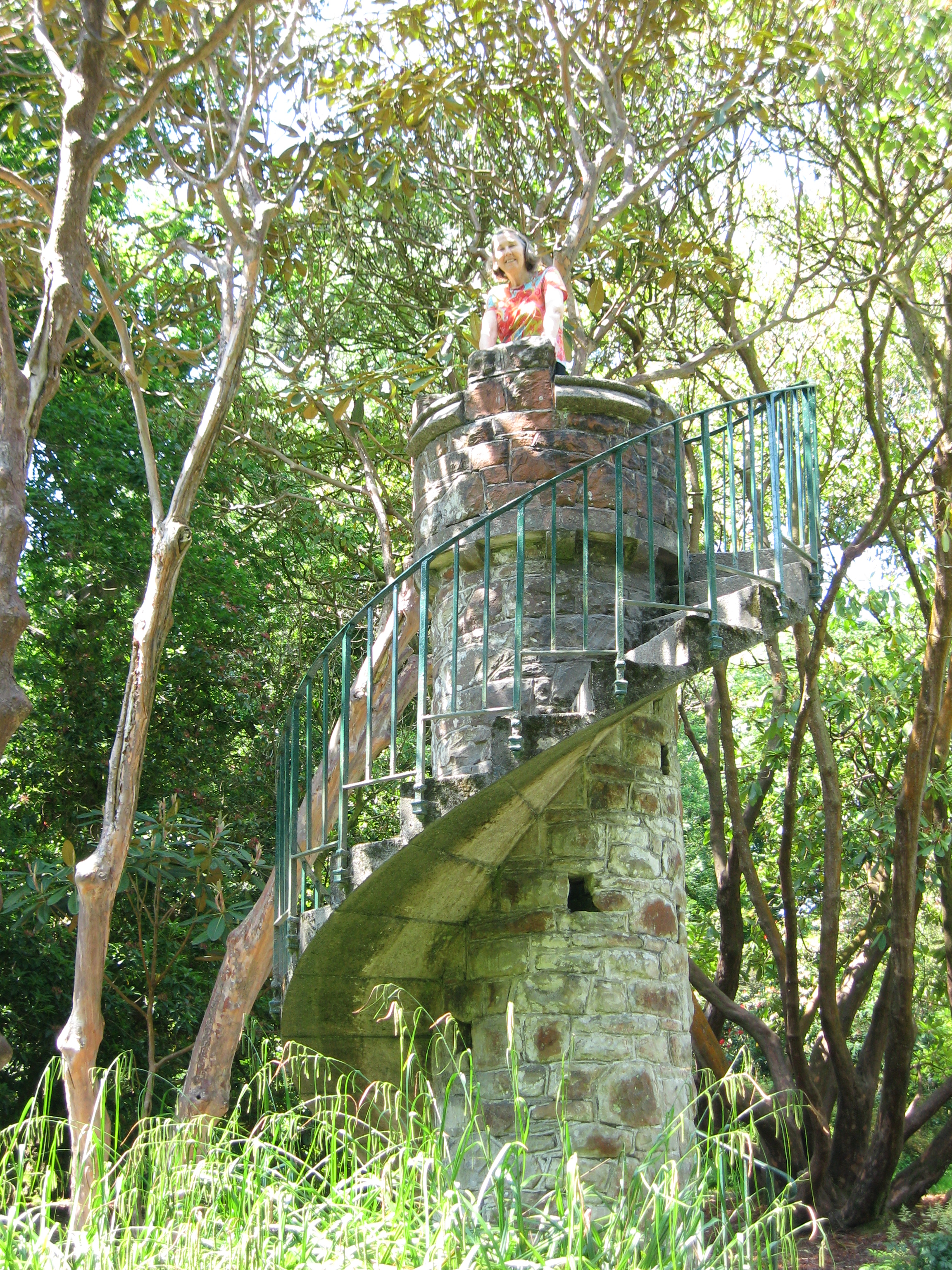
climb the tower, a “folly,” twenty steps up to nowhere
going round and round to the pinnacle and
stand among the tree tops and pink rhododendrons.
On my perch, in my American accent,
I would shout to the students
strolling in the gardens after dinner
(after we prayed in Latin at high table),
“Open your arms wide to life,
do you hear me,
you bloody, swotting fools?”
FEWalls
 In the notebook, five by eight inches, are examples of sewing arranged on lined paper that my mother made in high school. Cardboard, front and back, then a metal ring holds all the pages together. The examples of her work are in white cotton with white thread attached to each page with tiny gummed-back circles used then in photograph albums.
Her expertise shines in examples of the French seam, the hemmed felled seam, the mitered corner and the bias facing. Each sample pinked around the edges and labeled. The fagoted seam creates a small space between two pieces of cloth, ties them together with a single thread, barely catching each piece of fabric along the seam, twisting and looping the thread to hold the pieces together so delicately who could wear it without breaking? The example of a continuous placket was rated “good” in red pencil by the teacher.
The buttonholes carefully made: bound buttonhole, worked buttonhole with plain ends, worked buttonhole with bar ends.
The trade of tailors laid out: how to sew on a button, snap, hook. You can see how to smock, make a welt pocket or cord piping or the French tack.
She showed with shaped pieces of brown paper how to lengthen a pattern, shorten a pattern, change the pattern for narrow shoulders and larger hips or rounded back and flat chest.
Only the stitched felled seam was marked in red as “seam uneven.” For this, she received an “A-” for all her effort by her teacher.
Later, she could take the most complex Vogue pattern for a suit, lay it out on the wool or silk or cotton, cut it out, sew it up on a treadle machine, iron it and hang it in the closet (after the fashion show, of course).
She made her children’s clothes so each garment fit perfectly, so the lines flowed.
After World War II, she turned parachute silk into blouses with jabots. Then, some store-bought clothes appeared. Finally, she sewed no more. Then her fingers went still. She asked once late in life at a dinner party, what was the use of all this accumulated wisdom as we just die. Some days are like that, perhaps, but she did love to create beauty.
FEWalls
 When
When
I am turned to ash
I want you
knowing
that I hear your footfalls
in the ancient forest,
the scream of hawks,
the water crazy-mad flowing
down to the sea
and I want
you knowing
that I see you
on your knees in the garden
your hands a riot of colors
poppies, begonias, columbine and larkspur
that grow beneath you, beside you, near you
and I want you
knowing that I feel
your beating heart
a still-questing spirit
even with everything that has happened
so when I am ash
you will have these words
to sustain you.

